10 Reasons Brella Is the Best Event Networking Platform
Brella is the best event networking platform because it is the only one built from day one around a single goal: connecting the right people at events. Where most platforms started as registration tools and added networking later, Brella was founded in 2015 to solve event networking specifically — and the results show in the numbers: an average of 40% meeting acceptance rate, 530,000+ meetings facilitated in a single year.
This post breaks down the 10 reasons organizers, attendees, and sponsors keep choosing Brella over generic event apps.
What is Brella? Brella is the B2B event experience hub — one app where attendees discover sessions, book meetings, engage with sponsors, and stay connected with organizers throughout the event. Built around intent-based matchmaking, Brella powers networking, content, communications, and sponsor activation in a single platform — and plugs into your existing registration stack (Swoogo, Cvent, Eventbrite, Tito).
Brella vs. Typical Event Apps: At a Glance
|
Capability |
Brella |
Typical Event App |
|---|---|---|
|
Scope |
Full attendee experience hub |
Chat + agenda
|
|
Built around |
Networking & matchmaking |
Venue mgmt, Agenda, Chat |
|
Matchmaking logic |
Intent + interest |
Shared interests/chat |
|
Meeting acceptance rate |
avg ~40% |
Industry avg ~15–20% |
|
No-show rate |
Low (strategic partner avg) |
High |
|
Team coordination |
Built-in (see colleague meetings) |
None |
|
Sponsor analytics |
Dedicated dashboard |
Basic impressions |
|
Integration model |
Best-in-class layer + API |
Monolithic, all-or-nothing |
|
Meeting models |
Open + Managed + Hosted Buyer |
One, fixed |
1. Why Is Networking Brella's Foundation, Not a Feature?
Brella was founded in 2015 to solve one specific problem: event networking that depends on luck. Networking is not a module bolted onto a registration system — it is the architecture the entire platform was built around, from onboarding to meeting booking to post-event analytics.
Most event platforms started life as registration systems, badge printers, or venue management tools. Networking was added years later to check a box on a sales sheet. The result is a networking experience that feels designed by someone who has never attended an event: clunky, disconnected, and at odds with how people actually want to connect.
Many platforms even position a simple chat feature as “networking.” But messaging alone does not create meaningful business connections or measurable event outcomes.
Brella takes a fundamentally different approach. By designing matchmaking from the ground up and using AI to intelligently connect the right people at the right time, Brella delivers some of the highest meeting acceptance rates in the industry.
When networking is the central nervous system of the product, every interaction reinforces it. That is why attendees behave differently inside Brella than they do in apps where networking is a side feature.
2. Why is Brella the Hub of the Event, Not just a Meetings tools?
Brella is the single app attendees use throughout your event, and the platform that powers everything they do inside it. Meetings are the core, but Brella holds the whole attendee experience in one place.
Most "event apps" do one thing acceptably and the rest poorly: a chat-first app with a tacked-on agenda, an agenda-first app with no real networking, or a registration platform pretending to be an attendee experience. Attendees end up bouncing between disconnected tools and getting half the value from each.
Brella was built the opposite way: one app attendees actually open, one admin panel organizers actually use, one dataset connecting every interaction from check-in to follow-up.
Registration tools handle the gate. Brella handles everything inside it. That is the difference between an event app and an event hub.
3. How Does Intent-Based Matchmaking Work?
Brella matches attendees on intent — what each person wants to do — not just shared interests. Two fintech professionals might share an industry, but one wants to buy and the other wants to sell. Without intent, neither will know. With it, the first message has clear purpose.
Brella adds a second matching layer beyond topics: Buy. Sell. Seek investment. Find a mentor. Explore a new market. Hire talent.
That second layer turns a vague "maybe we should chat" into a meeting with a defined outcome. It is the difference between a hallway introduction and a boardroom conversation — and attendees notice it the first time they experience it.
4. What Is Brella's Meeting Acceptance Rate?
Brella's typical meeting acceptance rate is 40-60%, well above industry benchmarks, and a leading strategic partner running 100,000+ meetings per year achieves a 1.5% no-show rate compared to the 20–30% industry average. In a single year, Brella facilitated more than 530,000 meetings across 1000+ events — and the majority were booked before the event began.
A few numbers that matter:
- 530,000+ meetings facilitated in a single year
- 1000+ events powered annually
- 40%-60% average meeting acceptance rate
- Improved meeting quality rates
Attendees say yes because the meeting makes sense. They show up because the meeting was intentional from the start. When meetings actually happen, ROI compounds for everyone — attendees, sponsors, and organizers.
5. How Does Brella Prevent Duplicate Outreach From the Same Team?
Brella shows you when a colleague has already connected with someone — directly on that person's profile — so multiple reps from the same company never independently chase the same prospect. Your team can cover the room instead of duplicating effort.
Here is the scenario that plays out at every B2B event without this feature: three people from the same company independently reach out to the same prospect. It is wasteful for the prospect, embarrassing for the team, and a missed opportunity because no one is talking to the dozens of other relevant people in the room.
For sponsors and exhibitors sending multiple representatives, this visibility is the difference between a coordinated presence and a scattered one — a small detail with an outsized impact on how professional the team looks and how much value they extract from limited event time.
6. How Does Brella Measure Sponsor ROI?
Brella gives every sponsor a dedicated dashboard tracking profile views, meetings booked and accepted, leads scanned, meeting outcomes, and no-show data — so sponsors can prove pipeline value with data instead of gut feeling. That same data is what organizers use to defend renewals.
Sponsors invest in events to generate pipeline. Most event apps cannot tell them whether the investment paid off, which is a problem for sponsors and a bigger problem for organizers at renewal time.
With Brella, sponsors see not just how many people they interacted with, but who those people were, what they discussed, and whether the meeting actually happened. The renewal conversation shifts from "we think it went well" to "here is exactly what you got."
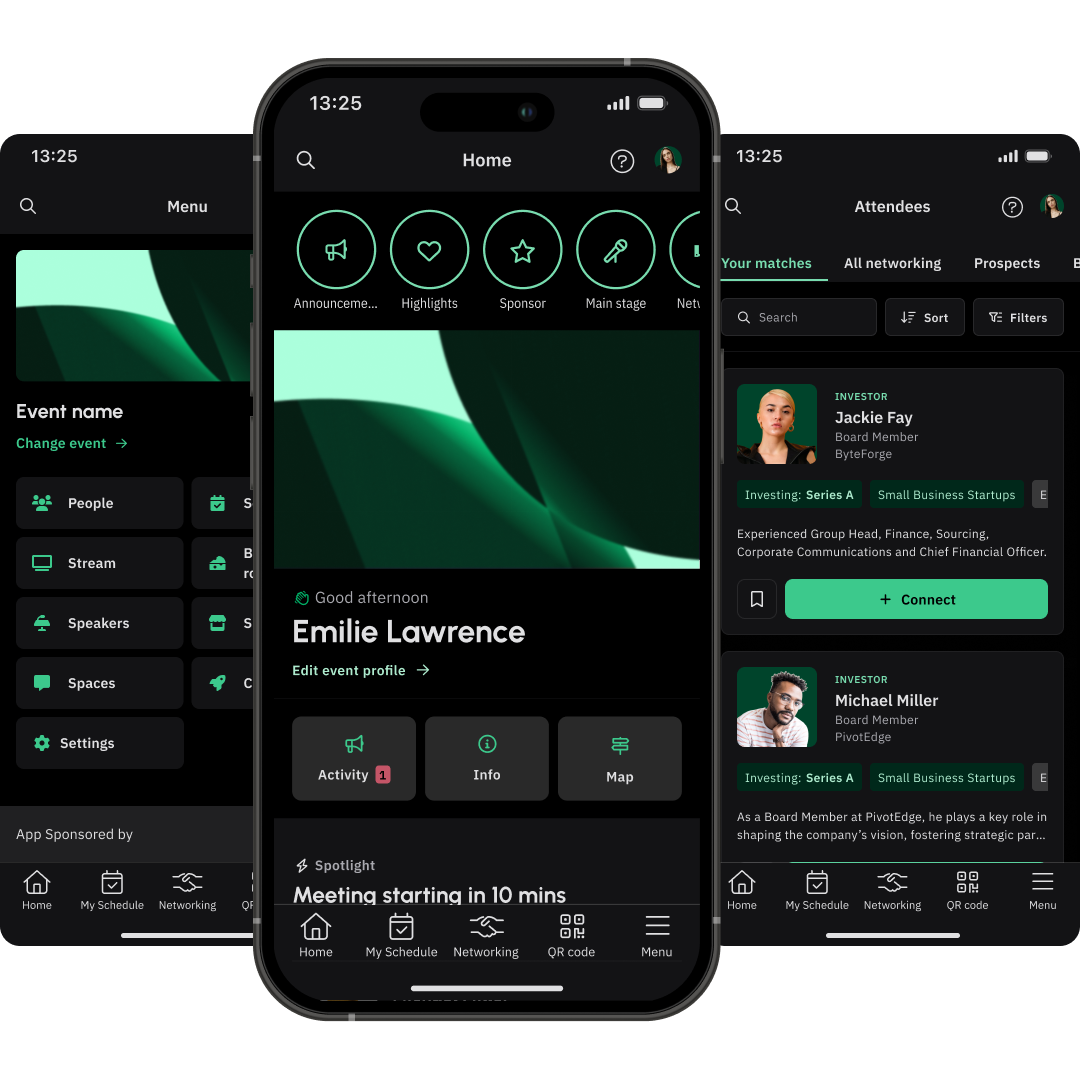
7. Why Does Brella Feel Like a Consumer App, Not Enterprise Software?
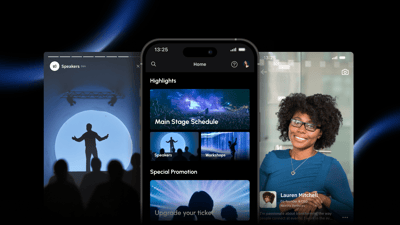
Brella was spun out of a digital design agency and uses navigation patterns people already know — Instagram-style Stories, TikTok-style Reels, Spotify -style search, and a "What's Next" feed — so attendees actually want to use the app. When people enjoy using the app, they book more meetings, engage more with sponsors, and get more from the event.
Most event apps still feel like enterprise software from a decade ago: tiny text, confusing navigation, nested menus burying the features people need. The assumption seems to be that business tools do not need to be pleasant.
That assumption is wrong, especially when the entire value proposition depends on people actively using the app. Good design is not cosmetic — it is a growth lever.
8. What Networking Models Does Brella Support?
Brella supports five networking models — Open Networking, Managed Meetings, Hosted Buyer Programs, Lead Scanning and Group Meetings — and all five can run in parallel inside the same event. That means a curated VIP track and general networking for all attendees can coexist in one app, one admin panel.
The 5 models:
- Open Networking — attendees browse recommendations and book meetings themselves
- Managed Meetings — organizers schedule on behalf of VIPs, buyers, or sponsors using Brella's matchmaking intelligence
- Hosted Buyer Programs — multi-phase workflows where buyers rank sellers, sellers approve requests, and the system generates a complete schedule
- Lead Scanning — the metrics every sponsor sees on their Brella dashboard — tracked alongside profile views, meetings booked, meeting outcomes, and no-shows.
- Group Meetings — let attendees schedule multi-participant, topic-driven discussions hosted by an organizer and co-organizer, with the event organizer controlling the maximum group size.
A 50-person executive summit needs a different experience than a 10,000-person trade show. Most platforms force you into one model. Brella adapts to yours — and grows with your event strategy whichever direction it takes.
9. How Does Brella Integrate With Existing Event Tech?
Brella does not do registration, badge printing, or event websites — it is a best-in-class engagement layer that plugs into Swoogo, Cvent, Eventbrite, Tito, or any platform with an API. Registrant, speaker, sponsor, and schedule data flow in automatically. No manual entry, no duplication, no syncing headaches.
This is the opposite of the monolithic platforms that try to own every part of the event experience. With Brella, you can switch your registration provider without switching your event app — and you are never locked into a platform that is mediocre at everything and excellent at nothing.
For organizers managing complex tech stacks, working alongside existing systems is not a convenience. It is a requirement.
10. What's on Brella's AI Roadmap?
Brella's near-term AI roadmap includes collaborative-filtering recommendations, automated meeting generation, Apple Live Activities and Google Live Updates for lock-screen meeting alerts, and configurable phased meeting workflows for hosted buyer programs. These are not distant ambitions — they are in active development, shaped by feedback from the thousands of events already running on Brella.
What's coming:
- Collaborative filtering — the same technique Netflix and Spotify use, applied to people. If attendees with similar profiles to yours booked someone, you'll see them surfaced.
- Automated meeting generation — machine learning produces optimal meeting schedules in seconds, with full organizer override.
- Lock-screen alerts — your next meeting and table number on your lock screen via Apple Live Activities and Google Live Updates, no unlocking required.
- Phased meeting workflows — structured sequences where buyers select, sellers approve, and the system fills gaps, all with custom messaging and configurable deadlines.
- Hosted buyer 2.0 — AI-first hosted buyer program
Built for Every Event Format
Brella adapts to different networking models instead of forcing one format. A startup-investor event with speed networking has different needs than a trade show with exhibitor booths and walking meetings — which is different again from an association conference with peer-to-peer learning.
The platform scales whether you are running a single 200-person event or a portfolio of 40+ events per year across multiple formats and industries.
Automated Scheduling, Done in the Background
Brella's scheduler allocates time slots and meeting locations automatically — removing decision fatigue for attendees and keeping networking traffic evenly distributed. No scrambling for a free table. No double-booked meeting points. No clustered sponsor schedules.
The system handles the logistics intelligently — balancing availability across time slots, meeting points, and participants — so people can focus on the conversation.
The Bottom Line
Brella is not the best event networking platform because it does the most things. It is the best because it does the most important thing — connecting the right people — better than anyone else.
At events, the most valuable thing that happens is a conversation between two people. Everything Brella builds is designed to make that conversation happen — and to make sure it is the right one.
Frequently Asked Questions
What is Brella used for?
Brella is an event networking platform used by B2B conferences, trade shows, summits, and association events to help attendees, sponsors, and exhibitors book high-value 1:1 meetings using intent-based matchmaking.
How does Brella's matchmaking work?
Brella matches attendees on two layers: shared interests (what topics they care about) and intent (what they want to do — buy, sell, raise capital, hire, find a mentor, etc.). The two-layer match produces meetings with clearer purpose than interest-only matching.
What is the average meeting acceptance rate on Brella?
Brella's average meeting acceptance rate is 38–40%, significantly above industry benchmarks. A strategic partner running over 100,000 meetings per year reports a 1.5% no-show rate, compared with the 20–30% industry average.
Does Brella replace my registration platform?
No. Brella is built as an engagement layer, not a full event-management stack. It integrates with Swoogo, Cvent, Eventbrite, Tito, and any registration platform with an API — so registrant, speaker, sponsor, and schedule data sync automatically.
Can Brella run hosted buyer programs?
Yes. Brella supports three networking models — Open Networking, Managed Meetings, and Hosted Buyer Programs — and all three can run in parallel inside the same event, managed from a single admin panel.
How does Brella prove ROI to sponsors?
Each sponsor gets a dedicated dashboard showing profile views, meetings booked and accepted, leads scanned, meeting outcomes, and no-show data. Organizers use the same data to defend renewals with evidence rather than gut feeling.
What types of events is Brella best for?
Brella is best for events where networking and meetings drive value: B2B summits, trade shows, association conferences, hosted buyer programs, startup-investor matchmaking events, and academic conferences. It scales from 200-person events to 10,000+ attendee shows.








%20(1ff).jpg?height=100&name=Brella_1%20(1)%20(1ff).jpg)